
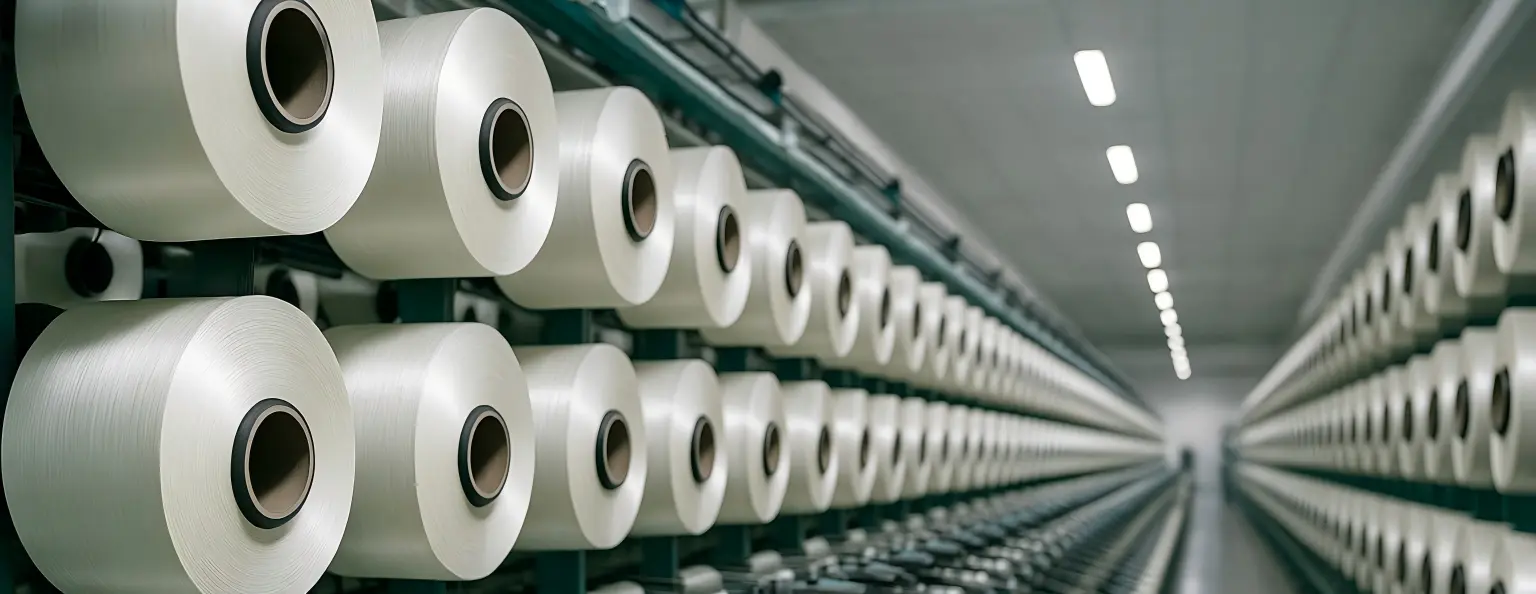
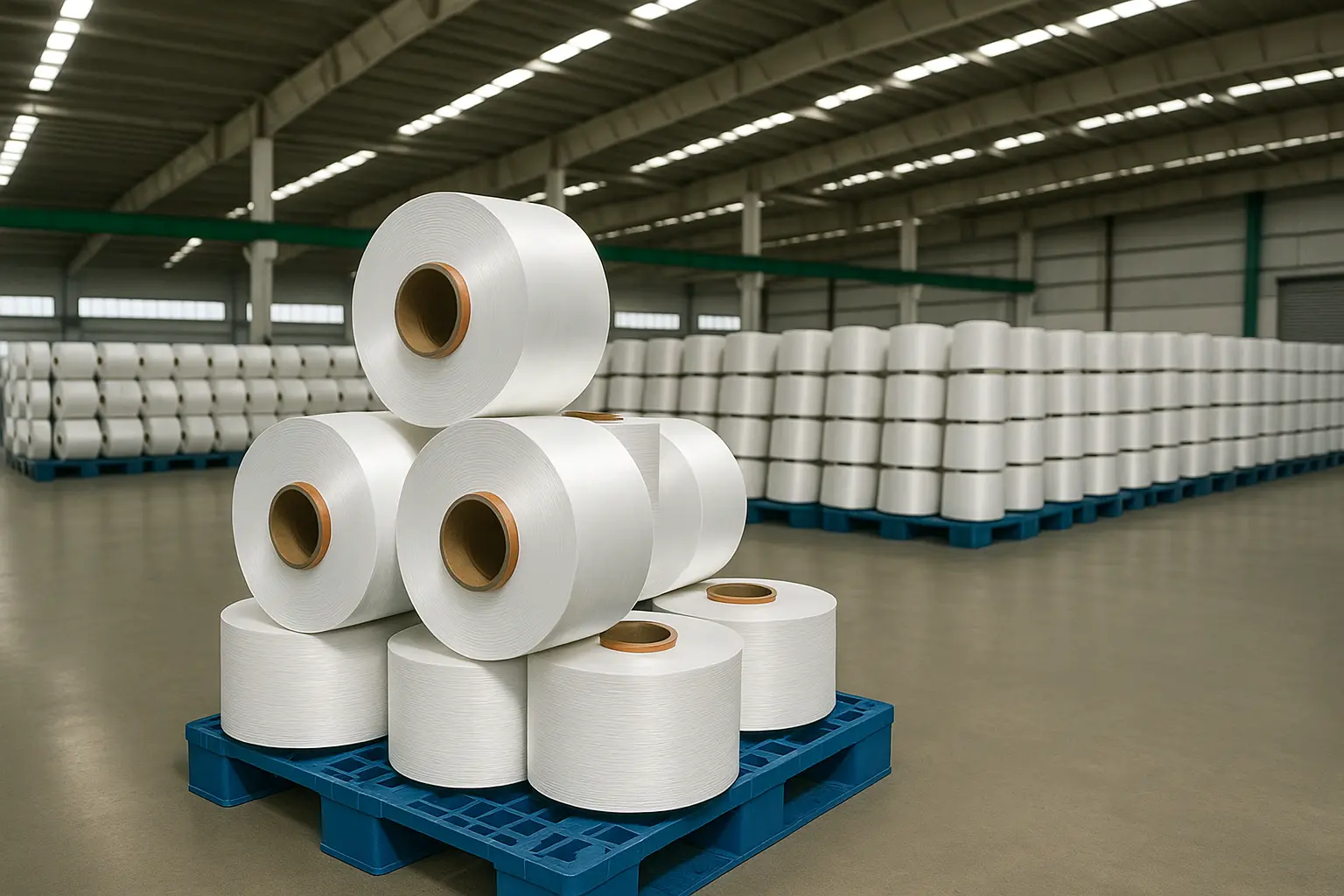
This warehouse showcases export-ready polyester FDY yarn stored in large, well-organised spools. The clean layout and structured pallet system highlight consistent production capacity and stable quality for international textile buyers.
Quick Summary
High-quality **Polyester FDY yarn** is the backbone of global weaving and knitting export markets. Yet identifying reliable export-grade FDY is far from simple. This guide breaks down the technical markers, testing parameters, defect-checking methods, and market expectations international buyers use when assessing premium FDY yarn — ensuring your sourcing decisions stay accurate, repeatable, and quality-driven.
Scene Introduction
“Why does this yarn look fine, but fail when it reaches our European clients?”
A textile supplier in Zhejiang asked this during a quality review meeting last month.
The export consultant simply replied:
“Because visual inspection is not quality assurance. Export-grade FDY yarn is defined by stability, consistency, and verified data — not appearance.”
This conversation reflects the reality of today’s global textile supply chain: buyers judge FDY through measurable performance, not promises.
Users’ Three Core Pain Points
1. Inconsistent yarn strength across batches
Many mills report full-denier FDY that behaves differently from cone to cone — causing unpredictable weaving performance.
2. High breakage rates during high-speed weaving
Low-tenacity or poorly spun yarn creates frequent loom stops, reducing production efficiency and raising operational cost.
3. Export rejection due to non-compliance
FDY that looks acceptable locally may fail in demanding regions (EU, Turkey, Middle East) because of uneven dye uptake, high shrinkage, or poor evenness.
Practical Solutions for Identifying High-Quality FDY Yarn
1. Check measurable mechanical performance
High-quality Polyester FDY yarn should achieve:
-
High tenacity (≥4.2 cN/dtex for general-purpose, ≥4.6 for high-strength)
-
Low elongation variation
-
Consistent Uster evenness (CV%)
-
Low hairiness and friction coefficient suited for high-speed weaving
These parameters determine whether an FDY can withstand long running cycles on modern rapier and air-jet looms.
2. Evaluate the yarn’s thermal and dyeing behaviour
Export buyers expect FDY yarn with:
-
Stable boiling-water shrinkage (BWS)
-
Uniform dye absorption
-
Smooth colour consistency during batch dyeing
If shrinkage fluctuates more than ±0.3%, fabric distortion and shade variation become noticeable — a major export-quality red flag.
3. Examine spool condition and winding precision
High-quality FDY for export has:
-
Neatly wound packages
-
No hard edges or collapsed sides
-
Stable tension throughout the bobbin
Poor winding leads to yarn slippage, breakage, and uneven fabric formation during high-speed weaving.
Industry Case Studies
Case Study 1: FDY for Export Home Textiles
A weaving mill producing bed sheets for the Middle East experienced:
• 9% loom stoppage rate
• Visible streaking in fabric
• High dye bath inconsistency
Switching to high-tenacity FDY with improved evenness CV% immediately reduced stoppage to 2.3%, cut dye variation by 40%, and improved export acceptance rate.
Case Study 2: FDY for Sportswear Fabric
A Vietnam-based knitting factory reported excessive pilling during garment testing.
Analysis showed low-oriented FDY with high hairiness.
After replacing it with low-friction FDY designed for circular knitting, the mill achieved:
-
0 pilling rating improvement from 3 → 4
-
30% fewer yarn breaks
-
Faster knitting efficiency
Data & Scientific Analysis
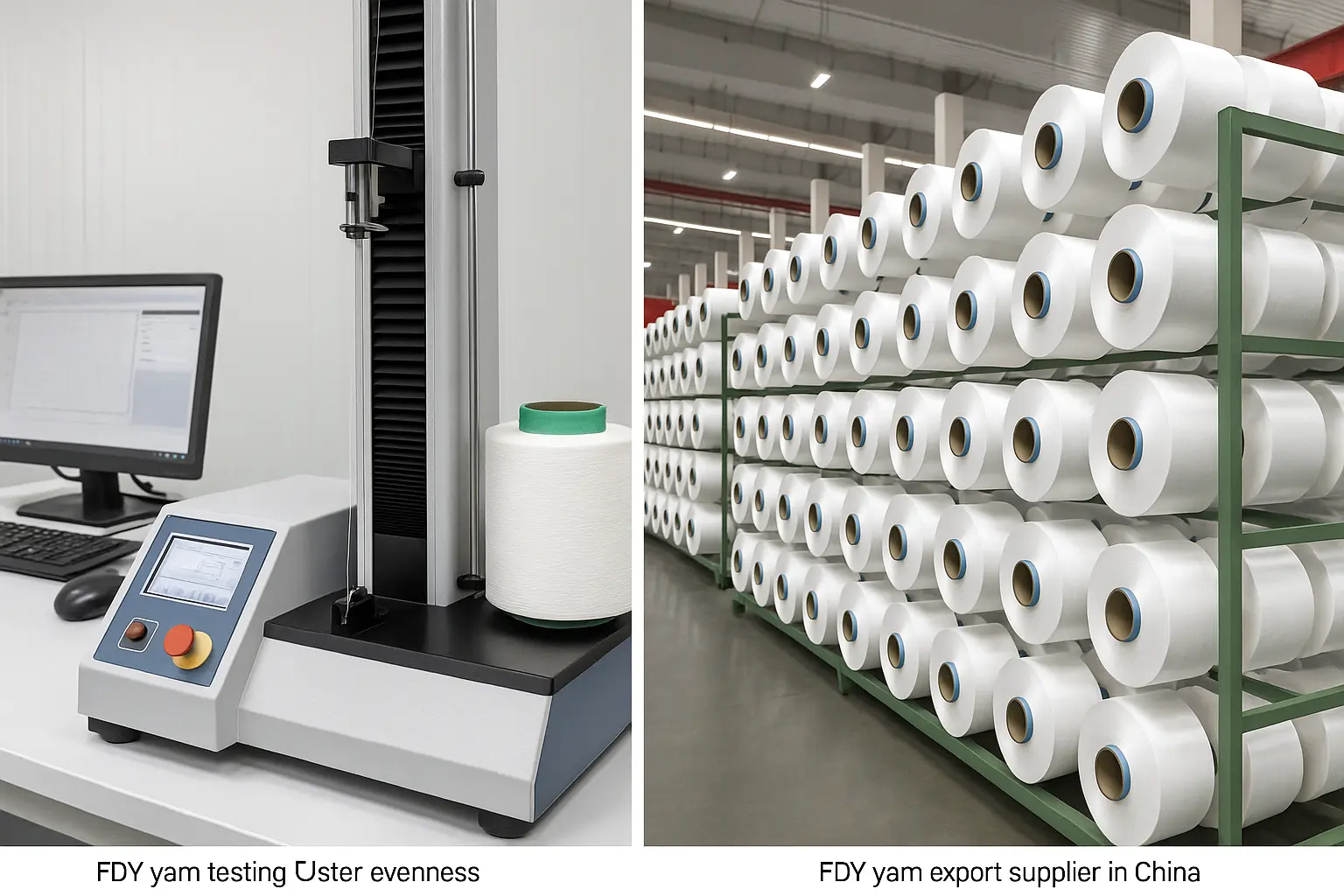
Global quality benchmarks for export-grade FDY yarn include:
Mechanical Standards
| Property | Export-Grade Requirement |
|---|---|
| Tenacity | ≥4.2–4.6 cN/dtex |
| Elongation | 18–22% depending on use |
| Uster Evenness CV% | ≤1.7% |
| Hairiness Index | Low to Ultra-Low |
Thermal Stability
-
BWS (Boiling water shrinkage): 5% ± 0.3%
-
DT (Dry heat shrinkage): ≤3.5%
Dyeing Consistency
-
ΔE colour variation: ≤1.2
-
Same-lot shade difference: minimal
These quantitative markers help buyers decide whether an FDY yarn is suitable for apparel exports, industrial weaving, or home textile markets.
Market Trends & Export Expectations
1. Europe demands higher consistency
EU buyers now prioritise stability over price, especially for sportswear and upholstery applications.
2. Middle East markets require heat stability
FDY with better thermal shrinkage performs significantly better in UAE, Saudi Arabia, and Qatar’s climate conditions.
3. Southeast Asia prioritises machine compatibility
Buyers in Vietnam, Indonesia, and Bangladesh increasingly look for FDY compatible with high-speed Jacquard, air-jet, and advanced circular knitting machines.
Usage & Quality Selection Advice
Select based on application
-
High-tenacity FDY → luggage fabrics, upholstery, technical textiles
-
Soft FDY → apparel, scarves, elastic fabrics
-
Low-friction FDY → circular knitting
Test before large orders
Request:
-
Uster test report
-
BWS report
-
Dyeing sample
-
5 kg trial cone for loom testing
Choose a stable manufacturer
Look for mills with:
-
Continuous polymerisation lines
-
Automatic winder systems
-
Uster-certified testing labs
-
Export inspection experience
Field Insight
Premium **Polyester FDY yarn** for export markets goes beyond tensile strength — buyers increasingly scrutinise evenness, shrinkage, lubricity, and high-speed weaving stability. At Anhui Power Win New Material Technology Co., LTD, FDY production relies on continuous polymerisation, precision spinning, and automated winding, ensuring uniformity across every lot. With controlled Uster parameters and stable dyeing performance, our export-grade FDY helps mills reduce downtime, enhance fabric uniformity, and pass stringent foreign testing standards.
Conclusion
Export markets judge FDY yarn by data, not appearance. By focusing on mechanical stability, thermal behaviour, evenness, and dyeing precision, textile mills can avoid costly rejections and maintain long-term export relationships. For buyers, selecting trustworthy suppliers with strict process controls is the only consistent way to secure premium-quality Polyester FDY yarn.
FAQ
1. What is the most important factor when evaluating export-grade FDY yarn?
Consistent tenacity, evenness CV%, and shrinkage stability are the core determinants.
2. How do I prevent FDY yarn breakage on high-speed looms?
Use low-friction, high-tenacity FDY and ensure precise winding and pre-conditioning before weaving.
3. Why does FDY sometimes dye unevenly?
The yarn may have inconsistent shrinkage or poor polymer uniformity — both affect dye uptake.
4. What FDY type is recommended for sportswear?
Low-friction, low-pill FDY with stable elongation and excellent dyeing uniformity.
5. How much variation in boiling-water shrinkage is acceptable?
Ideally no more than ±0.3%, otherwise fabric distortion can occur.
6. Does high-tenacity FDY always mean better?
Not always — apparel fabrics prefer balanced tenacity for softness.