
Mass-dyed filaments represent a significant trend in the chemical fiber industry towards green manufacturing, efficiency, and high performance. Through technological innovation, they address many pain points of traditional dyeing and finishing at the source, providing superior material options for downstream industries.
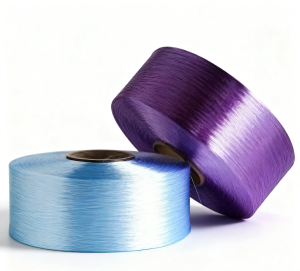
Mass-dyed filaments, simply put, are chemical fibers that are given their color during the production process. It does not refer to a specific material but is the product of a coloring technique. The table below provides a quick overview of the core information about mass-dyed filaments.
| Feature Dimension | Conventionally Dyed Fibers | Mass-Dyed Filaments (Dope-Dyed Fibers) |
|---|---|---|
| Coloring Technology | Fabric is dyed after weaving/knitting | Dope Dyeing: Color masterbatch is mixed with the polymer before spinning |
| Production Process | Spinning → Weaving/Knitting → Dyeing & Finishing | Spinning (with coloring) → Weaving/Knitting |
| Environmental Impact | High water and energy consumption, produces wastewater | Eliminates the dyeing process, significantly reducing pollution and water usage |
| Product Performance | Potential for color variation, dyeing may damage fibers | Excellent color fastness (color lasts), resistant to friction and washing, minimal fiber damage |
| Economy | Includes dyeing and finishing costs | Shortens downstream production, saves dyeing costs |
Core Technology: Dope Dyeing
The core advantage of mass-dyed filaments comes from their production technology – dope dyeing. This technology involves adding precisely formulated color masterbatch to the spinning melt or solution, allowing the color to be evenly and stably integrated into the fiber’s internal structure as it forms. This is fundamentally different from the conventional method where fibers are first produced and then colored in a subsequent dyeing process.
Main Categories and Applications
Dope dyeing technology can be applied to various chemical fibers. Common categories include:
-
Mass-Dyed Polyester (PES) Filaments: The most common type, available in various specifications (from 20D to over 1500D) and a wide range of colors. Widely used in home textiles, apparel lining, webbing, embroidery threads, etc.
-
Mass-Dyed Nylon (PA) Filaments: Especially Nylon 66, valued for high strength and good resilience, making it suitable for high-end outdoor gear, automotive interiors, premium socks, and lace requiring high performance.
-
Functional Mass-Dyed Filaments: Can incorporate additional functions like flame retardancy, UV resistance, moisture-wicking, antistatic properties alongside color, achieving multiple functionalities.
In summary, mass-dyed filaments represent a significant trend in the chemical fiber industry towards green manufacturing, efficiency, and high performance. Through technological innovation, they address many pain points of traditional dyeing and finishing at the source, providing superior material options for downstream industries.
FAQ:
1. What are mass-dyed filaments?
Mass-dyed filaments, also known as “dope-dyed fibers” or “spun-dyed fibers,” are chemical fibers where color masterbatch is added to the spinning melt or solution during the production process. This allows the color to be evenly integrated into the fiber’s internal structure as it forms. It refers not to a specific material, but to a coloring technique.
2. What is the difference between mass dyeing and conventional dyeing?
The key difference lies in the stage and process of coloring:
-
Conventional Dyeing: White fibers are produced first, then woven or knitted into fabric, and finally the fabric is dyed and finished.
-
Mass Dyeing: Coloring is completed at the source of fiber production (the spinning stage). Subsequent weaving or knitting can proceed directly, eliminating the dyeing and finishing steps.
3. What are the core advantages of mass-dyed filaments?
Their main advantages are evident in three areas:
-
Environmental Protection: It eliminates the subsequent dyeing and finishing processes, significantly reducing water consumption, energy usage, and wastewater discharge, making it more environmentally friendly.
-
Excellent Performance: The color penetrates the fiber’s interior, resulting in superior color fastness (resistance to sunlight, washing, friction). The color is long-lasting, and fiber damage is minimized.
-
Economic Efficiency: It shortens the downstream production流程, saving fabric and finished product manufacturers dye costs and dyeing/finishing processing fees.
4. Are the colors of mass-dyed filaments fast?
Yes, they are very fast. Because the color is distributed evenly during the fiber formation process, rather than being applied to the surface later, the color fastness (especially to washing and rubbing) is typically superior to that of conventionally dyed fibers.
5. What are the main types of mass-dyed filaments?
The most common types include:
-
Mass-Dyed Polyester (PES) Filaments: The most widely used type, available in various specifications, used for home textiles, garment linings, webbing, embroidery threads, etc.
-
Mass-Dyed Nylon (PA) Filaments: Especially Nylon 66, valued for high strength and good resilience, used in high-end outdoor products, automotive interiors, premium hosiery, and lace.
-
Functional Mass-Dyed Filaments: These can incorporate additional functions like flame retardancy, UV resistance, moisture-wicking, and antistatic properties alongside the color.
6. Why are mass-dyed filaments considered more eco-friendly?
Because they fundamentally eliminate the traditional dyeing and finishing processes, which are highly water-intensive, energy-consuming, and polluting. Estimates suggest that producing one ton of mass-dyed fiber can save tens of tons of water and significant amounts of electricity compared to conventional dyeing, while also avoiding the associated chemical wastewater.
Previous News
2025Guide Recycled Polyester: Weave a Sustainab...Next News
7 Reasons Why Polyester Filament is the Top Cho...