
=== There’s no single global “standard,” but most airlines accept carry-ons up to ~22 × 14 × 9 in (56 × 36 × 23 cm) and checked bags up to 62 linear inches/158 cm (L+W+H). Retail “standard” sets cluster at 20–22″ (carry-on), 24–26″ (medium checked), and 28–32″ (large checked). Duffels are sized by liters: ~35–45 L fits carry-on; 50–65 L for week-long trips; 70–90 L is usually checked. Always measure INCLUDING wheels/handles and confirm your airline’s page before you fly. ===
Why “standard luggage size” is confusing (and how to decode it)

The phrase standard luggage size is slippery because three different groups define “standard” in different ways:
-
Airlines care about gate sizers (for cabin bags) and linear inches (for checked bags). Airlines set the only dimensions that matter at the airport.
-
Retailers/brands group suitcases by nominal height (20/24/28 inches) and sometimes publish interior liters. These are shopping conveniences, not airport rules.
-
Travel communities (forums, subreddits) speak in practical outcomes: “Will it fit in the overhead?” “Will I pay oversize?” “Can I lift it?”
To cut through the noise, anchor on two global norms you will see again and again:
-
Carry-on (cabin bag): about 22 × 14 × 9 in (56 × 36 × 23 cm).
-
Checked bag: ≤ 62 linear inches / 158 cm (length + width + height), plus airline-specific weight limits (often 23 kg/50 lb in economy).
Everything else—product labels, “international vs domestic,” “small vs large”—maps back to those two anchors.
Quick reference: common size buckets (traveler + shopper view)
| Category | Typical Exterior Size (in) | Centimeters | Typical Volume | Trip Length Guide* |
|---|---|---|---|---|
| Under-seat personal item | 16–18 × 10–14 × 7–9 | 41–46 × 25–36 × 18–23 | 12–20 L | 0–2 days / tech kit |
| Carry-on | 22 × 14 × 9 | 56 × 36 × 23 | 35–45 L | 2–5 days |
| Medium checked | 24–26″ tall | 61–66 cm | 60–75 L | 5–9 days |
| Large checked | 28–32″ tall | 71–81+ cm | 85–120 L | 10+ days / winter |
| Duffel (carry-on) | 35–45 L | — | 35–45 L | 2–5 days |
| Duffel (checked) | 50–90 L | — | 50–90 L | 5–14 days |
*Trip length assumes typical clothing and no specialized gear. Heavy boots, formalwear, or winter layers can push you up one size.
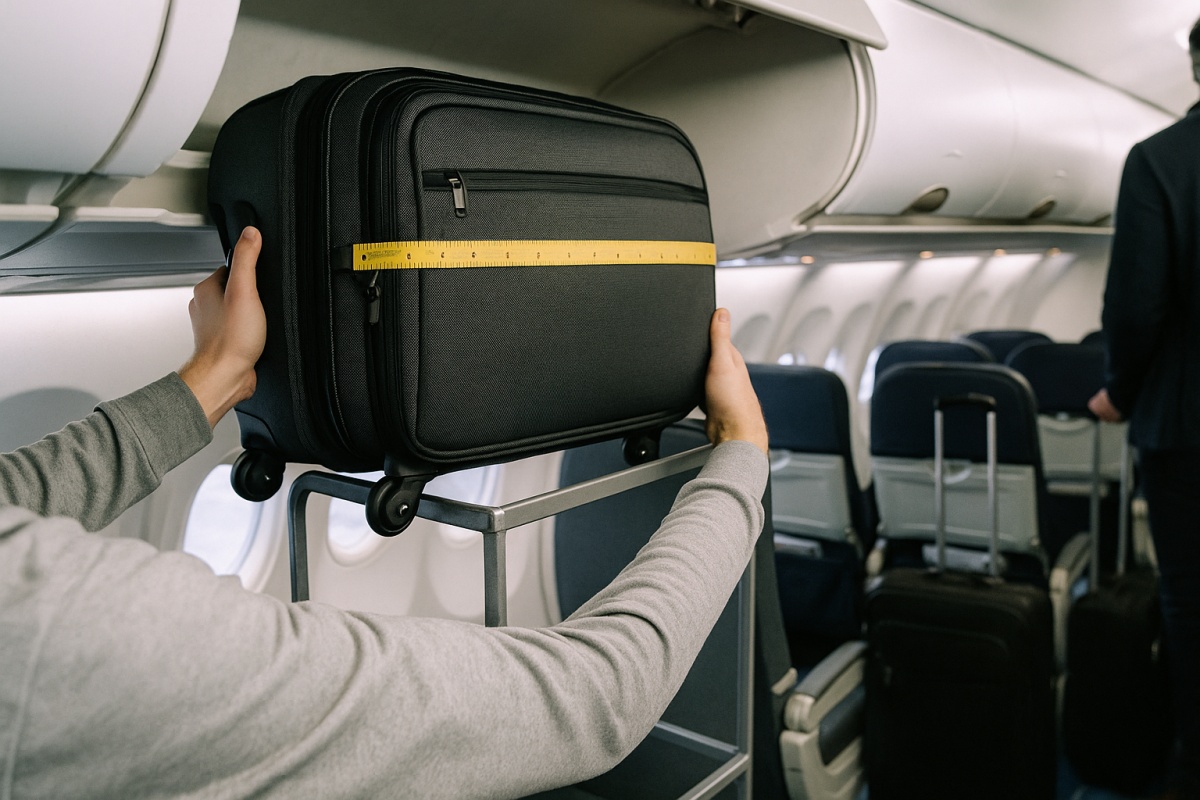
Measurement rule: Airlines measure the outside of your packed bag, including wheels, handles, caps, and bulging pockets.
Carry-on size: what airlines actually allow
Although every carrier publishes its own policy, the realistic baseline worldwide is:
-
Dimensions: ≈ 22 × 14 × 9 in (56 × 36 × 23 cm).
-
Weight: Often 7–10 kg (15–22 lb) in Europe and Asia; U.S. legacy airlines typically emphasize “lift to the overhead unaided” rather than a fixed number.
Regional patterns at a glance
-
North America (many legacy carriers): 22 × 14 × 9 in remains the de-facto template for sizers.
-
Europe (full-service vs ULCC): Full-service carriers are similar to the U.S.; ultra-low-cost carriers (ULCCs) more often restrict size/weight and charge for a larger “cabin bag.”
-
East Asia: Dimensions close to 56 × 36 × 23 cm, but weight limits (7–10 kg) are enforced more consistently at gates.
Evidence-based note: The 22 × 14 × 9 in box aligns closely to the IATA-promoted cabin guidance historically used to harmonize boarding, while the 62 in / 158 cm rule for checked luggage is near-universal across fare types. Regulatory agencies (e.g., TSA) focus on what’s inside your bag rather than its size; dimensions are published by airlines, not TSA or security authorities.
Practical carry-on tips
-
If your carry-on has an expander zip, keep it closed for boarding.
-
Softside and duffels flex into bins better, but still must drop into the sizer without force.
-
A 22″ hardside spinner can lose interior liters to shell thickness, wheel wells, and clamshell hinges. If interior yield is critical, consider a softside two-wheel roller (wheels often recess into the frame).
Checked baggage: the 62-linear-inch / 158-cm rule
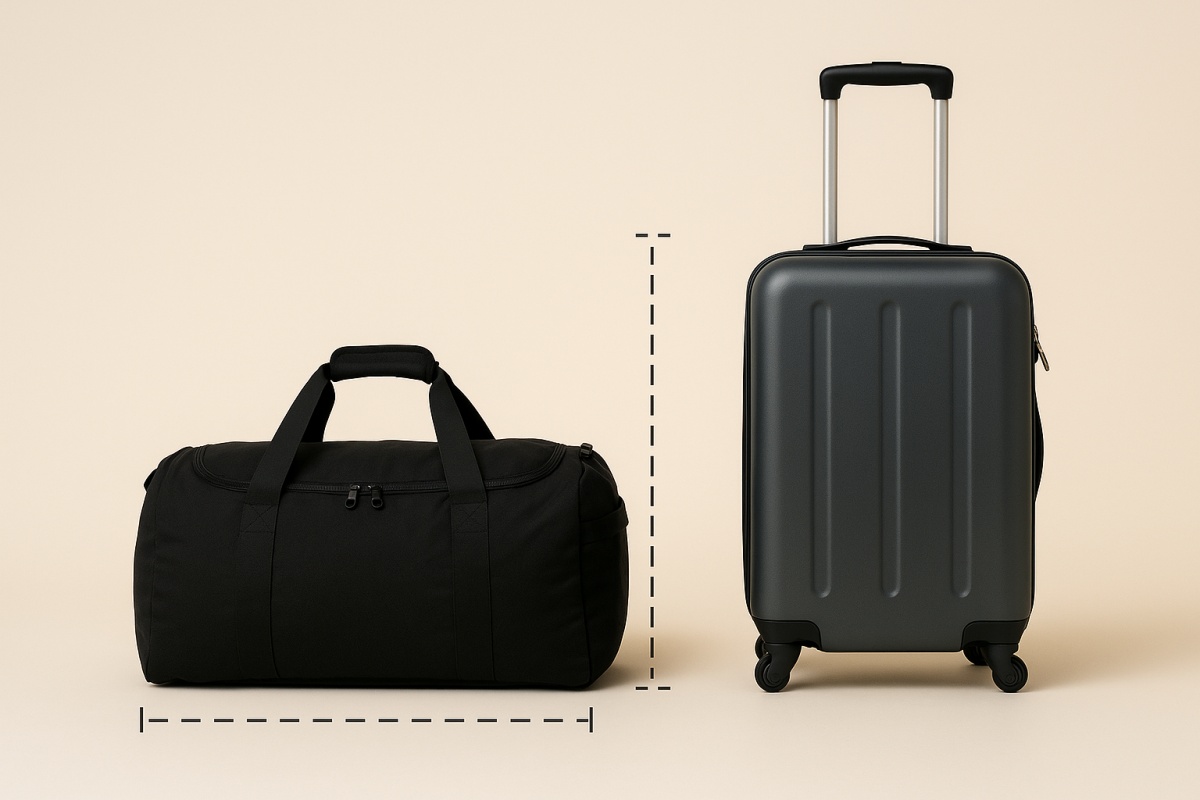
For most economy tickets worldwide, a checked suitcase meets size requirements when:
-
L + W + H ≤ 62 inches (158 cm) — measured at the longest points including wheels and handles.
-
Weight commonly ≤ 23 kg (50 lb) in economy; 32 kg (70 lb) limits exist in premium fares or special allowances.
Why linear inches? It lets airlines manage cargo hold volume with one number regardless of shape. Over that limit, oversize fees apply; you can also be charged overweight fees separately even if you are within 62″.
Medium vs large checked (and why it matters)
-
24–26″ cases (60–75 L) are versatile and less likely to exceed 23 kg.
-
28–32″ cases (85–120 L) hold a lot—but reach overweight faster once you add shoes, toiletries, and coats.
Cost reality: On many routes, one oversize/overweight fee can exceed the price of a second checked allowance purchased in advance. If your 30″ case often finishes > 23 kg, two 26″ cases can be cheaper and easier to lift.
Duffel bag sizing: liters, not inches
Duffels are sold by liter capacity, which better reflects soft-sided flexibility.
| Duffel Capacity | Typical Use | Cabin-friendly? | Notes |
|---|---|---|---|
| 25–30 L | Gym/day, ultralight weekend | ✅ Sometimes (as personal item) | Slim profile fits under seat on some carriers |
| 35–45 L | Weekend to 4–5 days | ✅ Usually | Ensure external dims stay within 22 × 14 × 9 |
| 50–65 L | 5–9 days mixed climates | ❌ Checked | Sweet spot for families who share packing cubes |
| 70–90 L | 10–14 days, gear-heavy | ❌ Checked | Expedition/wheeled duffels; mind 23 kg cap |
Why travelers love duffels: Best weight-to-volume ratio, stow easily in cars, and “give” a little in overhead bins. But a stuffed 45 L duffel that physically measures past 22 × 14 × 9 will still be gate-checked.
How to measure your luggage like an airline
-
Pack it first. Bulging pockets add an inch you didn’t plan for.
-
Measure the tallest, widest, deepest points using a rigid tape.
-
Include everything: wheels, handles, corner guards, straps, zipper pulls that protrude.
-
For checked luggage, compute linear inches = L + W + H.
-
Convert confidently:
-
1 in = 2.54 cm
-
1 L ≈ 61.0 in³ (interior volume estimate)
-
At-home sizer: Build a cardboard frame at 22 × 14 × 9 in. If your packed carry-on slips in and out freely, you’ve de-risked boarding.
Size vs trip length: realistic packing heuristics
-
Under-seat (12–20 L): essentials, meds, valuables, a spare outfit; pairs with any suitcase.
-
Carry-on (35–45 L / 22″): 2–5 days with cubes; up to a week if you plan laundry and pack for warm weather.
-
Medium checked (60–75 L / 24–26″): 5–9 days; two people can share one with compression.
-
Large checked (85–120 L / 28–32″): 10+ days, winter or sports trips; use a luggage scale to avoid overweight fees.
Winter math: A parka + boots + sweaters can consume 10–15 L fast. Move dense items (chargers, cosmetics) to your personal item to balance weight.
Construction choices that change usable space
-
Hardside (PC/PP/ABS): Sleek and protective; clamshell split can reduce the height of any single cavity. Look for thin but durable liners and flush wheel housings to reclaim liters.
-
Softside (ballistic nylon/cordura/poly): More forgiving in sizers; single deep cavity packs oddly shaped items better.
-
Spinners vs two-wheel rollers: Spinners maneuver easily but give up interior height to wheel pods. Two-wheel rollers often recess wheels in the frame and win on interior yield.
-
Expanders: Great on the return leg, risky on boarding. If expanded, re-measure depth before you leave for the airport.
Data-style insight: Independent product measurements consistently find 0.3–0.6 in of total exterior height added by wheel housings on spinners versus recessed two-wheel designs—enough to tip a “22 in” case out of a tight sizer when pockets are stuffed.
Airline & industry guidance that shapes “standard”
-
IATA coordination vs airline autonomy: IATA historically promoted 56 × 45 × 25 cm as a harmonized cabin guideline; many airlines adopt close variants (North America commonly uses 22 × 14 × 9 in). Guidance is not binding, which is why carriers differ.
-
Weight enforcement trends: European and Asian carriers more often weigh cabin bags (7–10 kg). North American legacies rarely publish a number but may size and “gate-check for space.”
-
Aircraft bins: New pivot-style overhead bins on narrow-bodies are optimized for wheels-first 22″ carry-ons, improving fit rate—but only if the bag meets depth limits.
-
Sustainability: Brands increasingly use recycled shells/liners and lighter frames, trimming hundreds of grams while maintaining the same exterior footprint—crucial where cabin weight caps are strict.
Retail “standard sets” vs OEM/factory specs (buyer-intent section)
If you’re buying/sourcing (manufacturer, factory, wholesale), expect a 3-piece set to map like this:
-
20–21″ (international carry-on)
-
24–26″ (medium checked)
-
28–30″ (large checked)
Spec sheet must-haves for OEM/ODM buyers:
-
Exterior dimensions with wheels/handles (+ tolerance).
-
Interior dimensions to lid line; usable volume (L) and method used.
-
Shell material & thickness; frame type (zipper vs frame-lock).
-
Wheelbase width/diameter; handle tube gauge & stages.
-
Empty weight (±2%); expander delta (mm).
-
Drop-test and tumble standards used (e.g., 1 m drop × n cycles).
-
Carton dimensions, nesting plan, CBM per 20′ / 40′ HQ, and units per pallet.
Wholesale/SEO long-tails to include:
luggage bag manufacturer, OEM luggage factory, private label 22×14×9 carry-on, duffel bag size wholesale, lightweight hard shell supplier, 24 inch suitcase medium, 28 inch checked luggage.
Regional snapshots: what to expect by market
| Region | Typical Carry-on Size | Usual Weight Rule | Checked Size Rule |
|---|---|---|---|
| North America | ≈ 22 × 14 × 9 in | Often unspecified; “lift unaided” | ≤ 62 in / 158 cm |
| Europe | ≈ 55–56 × 35–40 × 20–23 cm | 7–10 kg commonly enforced | ≤ 158 cm; 23 kg typical |
| East Asia | ≈ 55–56 × 36 × 23 cm | 7–10 kg widely enforced | ≤ 158 cm; 20–23 kg common |
Evidence-style note: Representative airline pages (e.g., full-service flag carriers and low-cost carriers) support these ranges; however, fare brands (basic economy, priority, “large cabin”) can override the default limits, so always check your exact ticket.
Measurement pitfalls that make a “legal” bag illegal
-
Measuring only the shell, ignoring wheels/handles (+1–2 in).
-
Overstuffing front pockets so depth creeps past 9 in.
-
“Expander creep” — the gusset unzips slightly in transit.
-
Assuming “international” labeling guarantees fit (some 21–22″ cases are too deep).
-
Duffel distortion: a 40–45 L duffel balloons past the sizer when packed with shoes and jackets.
Conversions, formulas & a worked example
-
Linear inches (checked):
L + W + H ≤ 62 in(≤ 158 cm). -
Liters ↔ in³:
1 L ≈ 61 in³(interior). -
In ↔ cm: multiply/divide by 2.54.
Example: A suitcase measuring 27 × 18 × 11 in
Linear inches = 27 + 18 + 11 = 56 in (under 62″). It’s a large checked height and can still be overweight when full. If you routinely hit 26–27 kg with this size, consider moving to two 24–26″ cases.
Size strategy by traveler type
-
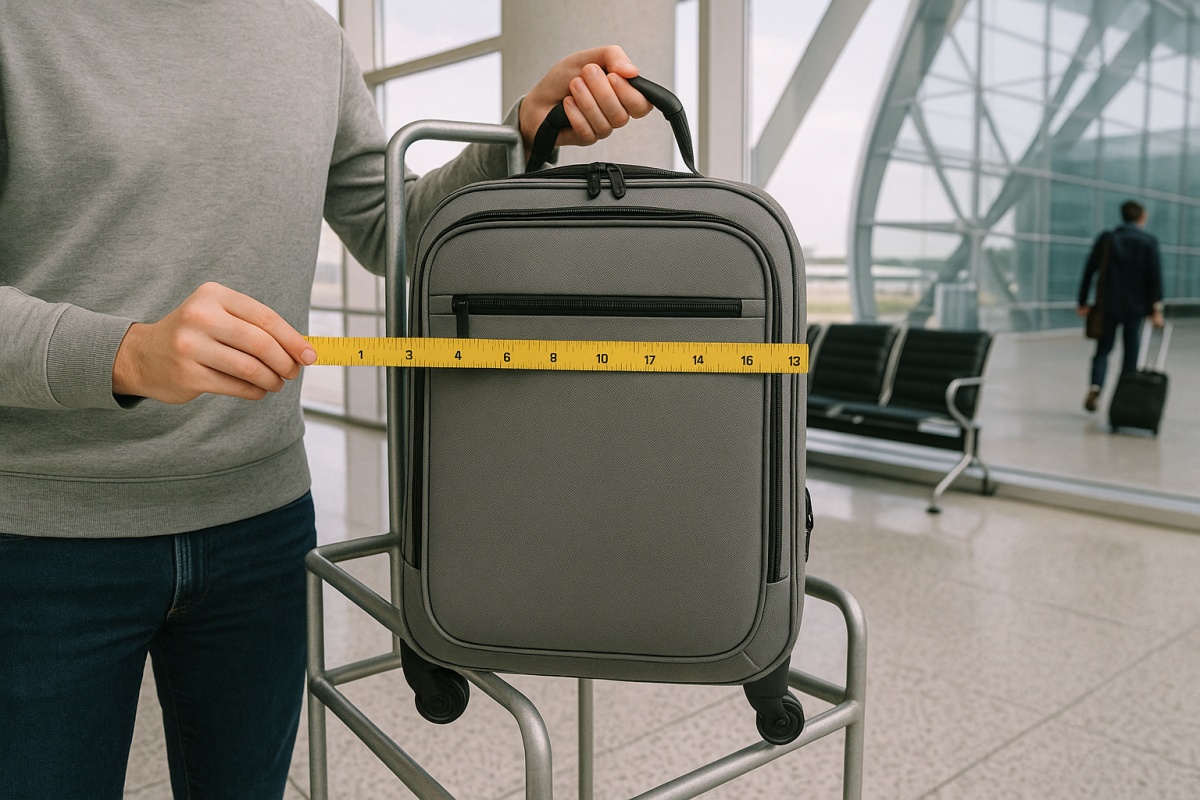
Business frequent flyer: Under-seat + strict 22″ softside roller; two-wheel for interior yield; abrasion-resistant fabric.
-
Family travel: Two 24–26″ mediums instead of one 30″; easier to lift and less risk of overweight fees.
-
Outdoor/expedition: 70–90 L wheeled duffel checked; fragile items in a rigid carry-on.
-
Budget/ULCC flyer: Personal-item-only strategy—16–18″ under-seat bag, compressible packing cubes, jacket pockets for overflow.
Comparison with brand & retailer guides (why they disagree)
Brand guides (Osprey, Travelpro, Travelite, Primark size charts, etc.) use consumer-friendly classes that line up with most airline norms but don’t control the gate. Airlines optimize for aircraft bins and boarding speed, and will:
-
Accept a 22″ spinner on a legacy carrier,
-
Reject the same bag on a ULCC that sells a “large cabin bag” upgrade, or
-
Gate-check compliant carry-ons on a full flight when bins fill.
Bottom line: Treat airline pages as the source of truth, use brand charts to choose a size, then leave safety margin (especially on depth).
Compliance checklist before you buy or fly
-
I measured my packed carry-on and it’s ≤ 22 × 14 × 9 in.
-
My fare includes a full-size cabin bag (not just a small personal item).
-
I know my route’s weight rules (7–10 kg common outside the U.S.).
-
My checked bag is ≤ 62 in / 158 cm and ≤ 23 kg / 50 lb (unless I bought more).
-
I can lift my carry-on into the overhead unaided.
Conclusion: the practical definition of “standard”
For travelers, “standard” boils down to three working rules:
-
Carry-on: target 22 × 14 × 9 in (56 × 36 × 23 cm).
-
Checked: keep L+W+H ≤ 62 in / 158 cm and watch the 23 kg weight cap.
-
Duffels: think liters—~35–45 L for cabin, 50–65 L for a week, 70–90 L when you must check.
For buyers (retail/wholesale/OEM), the consumer-friendly 20/24/28 set maps neatly to airline norms, but publish exterior dimensions with wheels and handles and state usable liters to reduce returns and chargebacks.
FAQ (Google hot searches)
1) What size is standard carry-on luggage?
Most airlines accept around 22 × 14 × 9 in (56 × 36 × 23 cm) including wheels/handles. Some carriers vary slightly—always verify your airline.
2) Do wheels and handles count in airline measurements?
Yes. Gate sizers measure total external dimensions, not just the shell.
3) What is 62 linear inches and why do airlines use it?
It’s L + W + H of a checked bag. Airlines use a single number to control hold space and handling without dictating shape.
4) What duffel bag size fits as a carry-on?
Aim for ~35–45 L and keep exterior measurements within 22 × 14 × 9 in. Soft sides help, but the packed bag must fit the sizer.
5) Are there universal international luggage size rules?
No binding global law. There are converging practices: North America commonly uses 22 × 14 × 9 for cabin and 62″ for checked; Europe/Asia are similar on size but often strictly weigh cabin bags (7–10 kg).
Semantic Closure: How/Why/What/Options/Considerations
Why: Prevent surprise gate checks and oversize/overweight charges; optimize bin fit; standardize buying and OEM specifications.
What: Carry-on ≈ 22×14×9 in; checked ≤ 62″/158 cm; duffel 35–45 L fits cabin; 24–26″ medium checked; 28–32″ large checked.
Options: Hardside vs softside; spinners vs two-wheel; expanders; under-seat + 22″ + 26″ kit; 50–65 L vs 70–90 L duffels.
Considerations: Fare brand and region; weight enforcement outside U.S.; winter bulk; interior yield lost to liners/wheel pods; OEM tolerances and carton CBM for wholesale.
Reference Source List:
-
Cabin Baggage Guidance — International Air Transport Association — IATA
-
Carry-on Baggage Policy — Editorial Team — American Airlines
-
Carry-on Baggage — Editorial Team — Lufthansa
-
Carry-On Baggage — Editorial Team — HK Express
-
Guide to Luggage Size — Editorial Team — Travelpro
-
Luggage Sizes — Editorial Team — Osprey
-
Suitcase Sizes — Editorial Team — Travelite
-
Airline Luggage Size Guidelines — Editorial Team — it luggage
-
Suitcase Size Guide — Editorial Team — Primark